
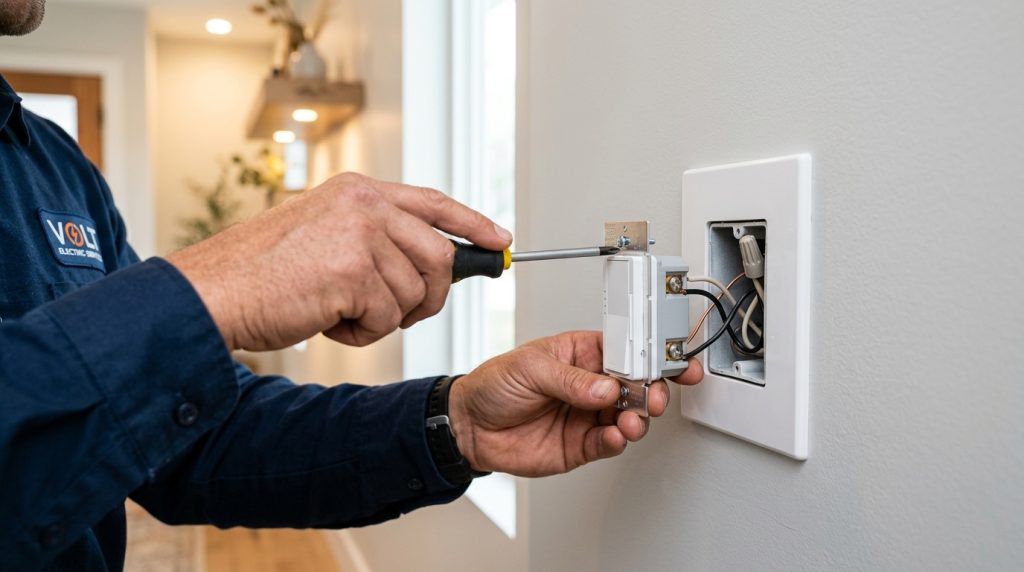
Installing a dimmer switch enhances home ambiance and energy efficiency but presents challenges in older electrical systems. Modern devices often require neutral wires that many mid-century homes lack. Improper DIY attempts can lead to serious fire hazards, electrical shocks, and violations of local building codes.
Professional installation ensures safety through system verification and compatibility checks for specific bulb types. Licensed electricians handle complex issues like aluminum wiring and three-way circuits while guaranteeing National Electrical Code compliance. These services prevent technical malfunctions like flickering and provide long-term security with labor guarantees and permits.
Adding a dimmer switch is one of the most effective ways to instantly upgrade the atmosphere of your home. Whether you’re trying to set the mood for a movie night in Harvey Park or adding some functional lighting control to your kitchen in Ruby Hill, a dimmer offers flexibility that a standard toggle switch just can’t match. It is about more than just light; it is about comfort and energy savings.
However, while it might seem like a simple “one-and-done” task, the reality of electrical work in older Southwest Denver homes is often much more complex than a YouTube tutorial makes it look. At Ponderosa Heating, Air, Plumbing, Electrical, we’ve seen many well-intentioned DIY projects in Westwood and Athmar Park turn into late-night emergency calls because of unexpected wiring configurations. Before you grab your screwdriver and head to the hardware store on Federal Blvd, let’s look at what goes into safe dimmer switch wiring in Colorado and why calling a pro might be the brightest idea for you and your neighbors.
DIY vs. Professional Comparison
To help you decide which path is right for your home, we’ve broken down the key differences between a “do-it-yourself” approach and hiring our licensed team:
| Feature | DIY Approach | Professional Installation |
| Safety Risk | High (Potential for shock or fire) | Zero (Licensed & Insured) |
| Tools Needed | You must buy or borrow | We bring professional diagnostics |
| Code Compliance | Uncertain | Guaranteed to meet NEC standards |
| Time Investment | 2–4 hours (plus hardware store trips) | Usually under 60 minutes |
| Future Value | Potential red flag during home inspection | Professional record of permitted work |
| Warranty | None (You pay for your own mistakes) | Satisfaction & Labor Guarantee |
The Challenge of Modern Tech in Older SW Denver Homes
Many homes in our local neighborhoods, particularly those built between the 1950s and 1970s, were wired during a very different era. Back then, a light switch was a simple mechanical on/off device. Today’s dimmers—especially “smart” dimmers that connect to your phone—are essentially small computers that manage the flow of electricity to your bulbs.
One of the most common hurdles we find in Westwood is the absence of a “neutral wire” in the switch box. In the mid-century era, electricians often ran a “switch loop,” meaning only the hot wire traveled to the switch. While a standard toggle switch does not need a neutral to function, many modern dimmers require that neutral wire to stay powered even when the lights are off. If you try to force a DIY install without understanding your home’s specific wiring layout, you could end up with a switch that does not work or, worse, a significant fire hazard behind your walls.
Pro Tip
If you open your switch box and only see two wires (usually black) and a bare copper ground, you likely do not have a neutral wire. Do not try to “bypass” this by using the ground wire as a neutral—this is a dangerous code violation that can lead to electrical shocks for anyone touching the switch plate.
The Reality of DIY Dimmer Switch Risks
The internet makes everything look easy, but DIY dimmer switch risks are very real when you are dealing with high-voltage electricity. Here are the most common issues our neighbors face when they try to go it alone:
- Arcing and Loose Connections: If a wire is not perfectly secured under the screw terminal or inside a wire nut, electricity can “jump” the gap. This is called arcing, and it generates intense heat that can melt plastic and ignite the wood studs inside your walls.
- Aluminum Wiring Dangers: Many homes built in the 60s and 70s in Southwest Denver used aluminum wiring. If you connect a standard copper-rated dimmer to aluminum wires without the correct “CO/ALR” connectors, the metals will expand and contract at different rates. This leads to a loose, dangerous connection that is a leading cause of home fires.
- The “Hum” and “Flicker”: Using a dimmer that is not matched to the wattage or type of your bulbs (LED vs. incandescent) will not just be annoying—it can actually shorten the life of your expensive fixtures and the switch itself.
Pro Tip
Always check the “Load Rating” on your new dimmer. If you are trying to dim a large chandelier with 12 bulbs, a standard low-wattage dimmer might overheat. We always calculate the total wattage of your fixtures to ensure your home stays protected and your lights stay steady.
The Ponderosa Process: How We Help Our Neighbors
When you hire an electrician for light switch installation, you are not just paying for a device to be swapped; you are getting a comprehensive safety check for your home. We treat every job like we are working on our own neighbor’s house. Our process is designed to give you total peace of mind:
- System Verification: We do not just pull wires; we test your existing wiring with professional meters to ensure it can safely handle a dimmer upgrade without overloading the circuit.
- Box Volume Assessment: Modern dimmers are much larger than old switches. We ensure your electrical box is not “over-filled,” which is a common cause of pinched wires and short circuits.
- Compatibility Check: We verify your dimmer is perfectly matched to your specific light bulbs to prevent that frustrating flickering and buzzing.
- Circuit Inspection: While the box is open, we look for signs of heat damage or “brittle” insulation that might indicate a larger problem in your home’s grid.
- Expert Grounding: We ensure the circuit is fully grounded to current safety standards, protecting your family from accidental shocks.
If we find that your overall electrical system is struggling to keep up with modern demands, we can even discuss more significant safety upgrades, like a whole house generator to protect your home during those heavy Colorado mountain storms or Metro area outages.
Dimmer Installation FAQ
To help you decide the best path for your home, here are a few questions we frequently hear from neighbors in the Metro Area:
Is a dimmer install cost expensive?
The cost of a professional installation is an investment in safety. When you consider the potential cost of a fire or damaged electronics from a bad DIY job, the value of a pro is clear. To help our neighbors stay safe without breaking the bank, we offer flexible financing options for larger electrical projects.
Why is my new dimmer humming?
This usually happens when the dimmer isn’t compatible with the bulbs you are using. It’s a common issue with newer LED bulbs being placed on old-style dimmers. A professional can quickly identify the right dimmer-to-bulb ratio to keep your home quiet and bright.
Can I install a dimmer on a 3-way switch?
A 3-way switch (where two switches control one light, common in hallways) is significantly more difficult to wire than a standard switch. One wrong wire can lead to a short circuit or a switch that only works half the time. This is a task we strongly recommend leaving to a licensed local expert.
Our Satisfaction Guarantee
At Ponderosa, we treat every home like it’s our own. We don’t believe in using fancy jargon or complicated explanations—just local, neighborly help to fix your problems and protect your property. We are so confident in our work that we provide a satisfaction guarantee on every installation we perform. Whether we are helping you with a single switch or explaining the signs of a failing water heater, our goal is to be your trusted home partner.
Let Ponderosa Handle the Highlights
Do not spend your weekend frustrated with tangled wires and flickering lights. Let our friendly, neighborly experts handle your electrical needs so you can simply enjoy the new ambiance of your home. Electrical safety is a serious matter, and according to the Electrical Safety Foundation International (ESFI), thousands of home fires are caused each year by electrical malfunctions that could have been prevented with a professional eye.
Our initial service call fee is $189, but this is completely waived (making your quote free) if you choose us for the work. If you try to DIY and run into a wall, you will still need a pro to come fix it—starting with a pro avoids the headache and ensures the job is done right the first time.
Call us today at 720-470-1133 or fill out our online contact form to schedule your professional dimmer switch installation in Denver. We’re ready to help keep your home bright, safe, and modern.
Ponderosa Heating, Air, Plumbing, Electrical
Golden Office: 15750 S Golden Rd #J, Golden, CO 80401
Conifer Office: 26267 Conifer Rd Unit 209, Aspen Park, CO 80433
Phone: 720-470-1133
