
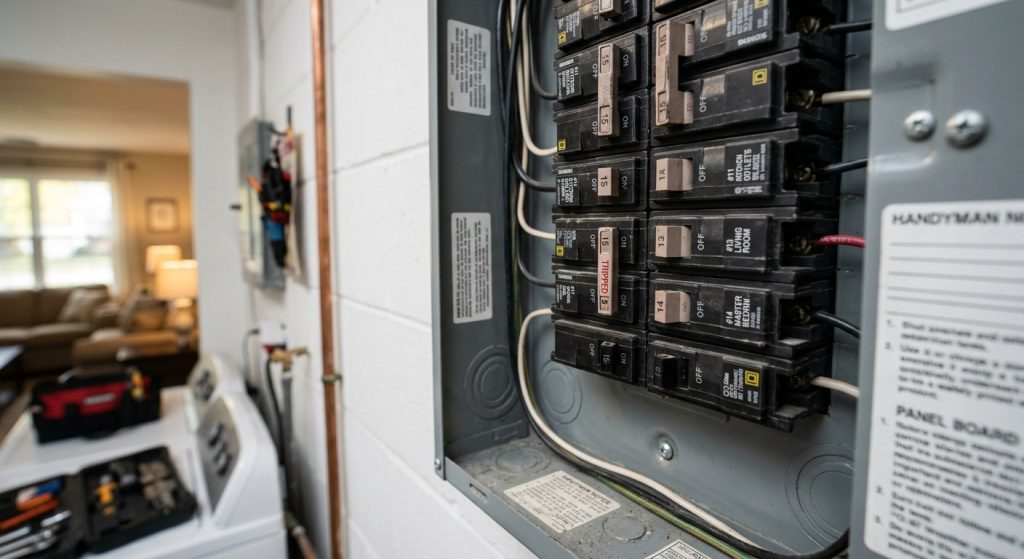
Circuit breakers trip as a safety measure to prevent electrical fires caused by overheating wires. Common causes include overloaded circuits, short circuits, ground faults, and aging hardware. In older homes, modern electrical demands often exceed the capacity of original systems, necessitating professional upgrades to maintain safety and functionality.
Attempting DIY electrical repairs poses significant risks, including lethal electrocution and increased fire hazards from improper breaker sizing. Professional electricians ensure repairs meet local building codes and permitting requirements. Addressing frequent tripping promptly protects property and ensures the electrical system can safely support modern appliances and technology.
Understanding Why Your Circuit Breaker Keeps Tripping
It’s one of the most common and frustrating household problems. You’re in the middle of making dinner, working from your home office, or watching a movie, and suddenly, the power cuts out in one section of your house. You walk to your electrical panel, find the flipped switch, and reset it. But a few minutes later, it happens again.
If you are dealing with a circuit breaker that keeps tripping in Denver, your home is actively trying to warn you about a problem. A tripping breaker isn’t a nuisance; it is a vital safety mechanism designed to protect your home’s wiring from overheating and catching fire.
In older, historic neighborhoods like Harvey Park and Athmar Park, many homes still rely on electrical systems designed decades ago. These older panels simply weren’t built to handle the immense electrical load of modern technology. At Ponderosa Heating, Air, Plumbing, Electrical, we help our Southwest Denver neighbors solve these frustrating power issues every single day.
Here is an in-depth, technical guide to understanding exactly why your breaker trips, the hidden dangers of ignoring the problem, and when you need to skip the DIY attempts and call a local professional.
The Top 4 Causes of a Tripping Circuit Breaker
When we arrive at a home to diagnose a power loss, we are generally looking for one of four specific culprits. Understanding these causes can help you troubleshoot the basics before scheduling a repair.
1. The Overloaded Circuit
This is by far the most common reason a breaker trips. Every circuit in your home is rated to handle a specific amount of electrical current, measured in amps (typically 15 or 20 amps for standard wall outlets).
An overload happens when you try to pull more electrical current through the wire than it is rated to safely carry. For example, if you plug a high-draw space heater, a gaming computer, and a laser printer into the same bedroom circuit, the total amperage required will quickly exceed 20 amps. The breaker senses that the wire is getting too hot and immediately shuts the power off.
The Overloaded Circuit Fix: The easiest overloaded circuit fix is simply moving one of your heavy-draw appliances to a completely different room (and therefore, a different circuit). However, if your kitchen is constantly tripping because you want to run the microwave and the air fryer at the same time, shuffling appliances isn’t practical. In that case, you need a professional to pull a brand new, dedicated circuit from your panel directly to your kitchen.
2. A Short Circuit
If you reset your breaker and it instantly trips again with a loud “pop,” you likely have a short circuit. This is a severe fire hazard.
A short circuit occurs when a “hot” (energized) wire accidentally touches a “neutral” wire anywhere in the system. This allows the electricity to bypass the normal path of resistance (like flowing through a lightbulb) and surge violently. This massive, sudden surge of heat will instantly trip the breaker. Shorts are often caused by loose wire connections inside an outlet box, a damaged appliance cord, or pests (like mice) chewing through the wire insulation inside your walls.
3. A Ground Fault
A ground fault is a specific type of short circuit. Instead of the hot wire touching a neutral wire, the hot wire touches the bare copper ground wire, or the metal side of the electrical box.
Ground faults are particularly dangerous because they often occur in areas where electricity and water mix, such as kitchens, bathrooms, and outdoor patios. This is why modern building codes require specialized GFCI protection for kitchens and baths. If your breaker is tripping due to a ground fault, you need a professional to trace the fault and repair the exposed wire immediately to prevent a lethal electrical shock.
4. A Failing Circuit Breaker
Circuit breakers are mechanical devices with internal springs and bimetallic strips. Like the brake pads on your car, they eventually wear out. If your breaker has tripped dozens of times over the years, the internal spring mechanism can become weak. A weak breaker will “nuisance trip”—meaning it will shut off the power even when the circuit is perfectly safe and not overloaded. If you suspect this is the case, you can read our detailed guide on how to tell if a circuit breaker is bad for more warning signs.
Why DIY Electrical Panel Work is Extremely Dangerous
When faced with a weak breaker or a kitchen that needs more power, some homeowners are tempted to buy a new breaker at the hardware store and attempt to install it themselves. We strongly advise against this.
Here is exactly why DIY panel work is dangerous and why you need to call an electrician:
The Lethal Risk of Arc Flash Even if you flip the main breaker at the top of your panel to the “Off” position, the thick service lugs bringing power in from the street remain fully energized with raw, un-fused electricity. If your hand slips or your screwdriver brushes against these live lugs while trying to snap a new breaker into place, it can result in a blinding arc flash explosion or a fatal electrocution.
Incorrect Breaker Sizing The most dangerous DIY mistake is attempting an “overloaded circuit fix” by simply swapping a 15-amp breaker for a larger 20-amp breaker. The breaker is sized specifically to protect the thickness of the wire inside your walls. If you put a 20-amp breaker on a wire only rated for 15 amps, the breaker will never trip. Instead, the wire will overheat, melt its insulation, and start a massive fire inside your drywall.
If your panel is constantly tripping, making buzzing noises, or feels warm to the touch, you need to have a professional evaluate if your electrical panel is a fire risk.
Local Permitting Nuances in Denver
When your home needs more electrical capacity to stop the constant tripping, you aren’t just performing routine maintenance; you are structurally modifying the home’s infrastructure.
In the City and County of Denver, adding new dedicated circuits, upgrading a breaker box, or installing an electrical sub-panel legally requires pulling a structural electrical permit. This ensures that an independent municipal inspector verifies the wire sizing, the torque on the breaker lugs, and the safety of the entire installation.
If you hire an unlicensed handyman who skips the permitting process, you are inheriting a massive liability that could void your homeowner’s insurance policy. Because Ponderosa operates locally in Southwest Denver every single day, we understand these building codes inside and out. We handle the entire complex permitting and inspection process for you, ensuring your electrical upgrade is 100% legal, up to code, and safe.
Frequently Asked Questions: Tripping Breakers
Why does my AC keep tripping the breaker in the summer? Air conditioners draw a massive amount of amperage when the compressor first starts up. If your AC is old and struggling, or if the outdoor unit is clogged with dirt and debris, the compressor has to work much harder to start, causing an “over-amp” situation that trips the breaker. You need an immediate HVAC diagnostic to save the compressor from burning out completely.
Is it safe to just keep resetting a tripped breaker? No! If a breaker trips once, it might be a fluke. If it trips two or three times in a row, leave it off. Forcing a breaker to stay on when the system is trying to shut down is a guaranteed way to cause an electrical fire.
How much does it cost to add a new circuit to my house? The cost depends heavily on how far the new outlet is from your main electrical panel and whether your basement is finished (which requires us to fish wire through closed drywall). However, adding a dedicated circuit is the safest, most permanent solution to an overloaded kitchen or home office.
The Complete Home Services Advantage
Navigating the dense residential neighborhoods and heavy traffic of Southwest Denver is challenging enough; you shouldn’t have to deal with the stress of losing power every time you try to dry your hair or cook dinner.
When you call Ponderosa Heating, Air, Plumbing, Electrical, you are calling a complete home services partner. We pride ourselves on providing clear, honest explanations and high-quality craftsmanship that lasts. We don’t just “flip a switch” and walk away; we find the root cause of the electrical fault to protect your family and your property.
Our initial service call fee is $189, but this is completely waived (making your quote free) if you choose us for the work.
Call us today at 720-470-1133 or fill out our online contact form to schedule your professional electrical diagnostic. Let’s make sure your Southwest Denver home stays bright, powerful, and completely safe.
