
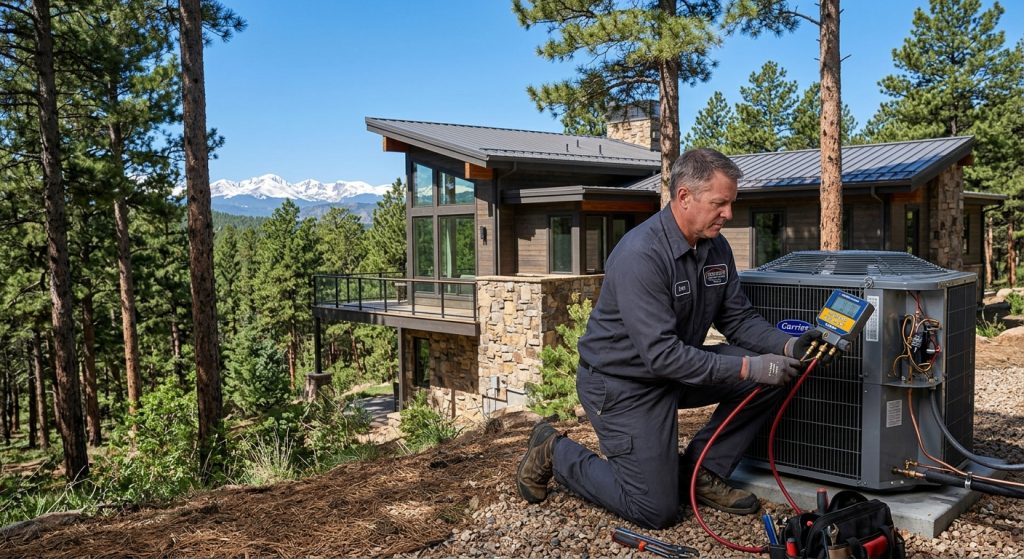
High altitude significantly impacts air conditioning performance in mountain regions like Conifer. Lower air density reduces heat transfer efficiency, requiring systems to be specially calibrated or derated for elevation. Factors such as intense solar radiation and low humidity also influence the effectiveness and longevity of cooling equipment.
Proper maintenance and specialized installation are essential for mountain HVAC systems. Technicians must account for environmental challenges like pine debris and increased electrical wear. Modern heat pumps offer an efficient alternative, providing variable-speed cooling and heating tailored to the unique climate and atmospheric pressure of high-altitude environments.
Does High Altitude Affect Air Conditioning in Conifer?
Living in Conifer, Aspen Park, or over in Kings Valley comes with some of the best views in the world. But at 8,000 to 9,000 feet above sea level, we aren’t just living in the mountains—we are living in a unique physical environment that challenges our home’s mechanical systems in ways people down in Denver or Golden never have to worry about.
One of the most frequent questions we hear at our Conifer office is: “Does altitude affect ac” performance? The short answer is a resounding yes. From the way heat is transferred between coils to the way your blower motor moves “thin” air through your ductwork, high-altitude living fundamentally changes the math for your cooling system. At Ponderosa Heating, Air, Plumbing, Electrical, we specialize in high-altitude HVAC. Here is a technical look at how high altitude ac in Conifer works and how to optimize your comfort when the thin mountain air gets hot.
The Science of Thinner Air and Heat Transfer
The single biggest factor in mountain cooling is air density. As we climb higher into the Front Range, the atmospheric pressure drops. This results in “thinner” air, which simply means there are fewer air molecules in every cubic foot of space compared to sea level.
Air conditioning systems operate on the principle of heat exchange. Your indoor evaporator coil absorbs heat from your home’s air, and the outdoor condenser unit “dumps” that heat into the outside atmosphere. Because the air in Conifer is roughly 25% less dense than at sea level, there is significantly less “mass” available to carry that heat away.
Think of air molecules as a fleet of tiny trucks carrying heat. In Denver, you have a full fleet; in Conifer, you’re working with 75% of those trucks. This means your outdoor unit has to work harder, run longer, and operate at higher internal temperatures to move the same amount of heat. This leads to increased wear and tear on the compressor and fan motor if the system isn’t properly calibrated for the elevation.
The “Derating” Factor: Why 3 Tons Isn’t Always 3 Tons
In the HVAC industry, we use a process called “derating” for high-altitude installations. Because the air is a less efficient cooling medium, an AC unit that is factory-rated for 3 tons of cooling at sea level might only provide 2.4 or 2.5 tons of effective cooling at 8,000 feet.
If a contractor from the city uses standard “flatland” sizing charts or “rules of thumb,” they will almost certainly leave you with an undersized system. An undersized unit in the mountains will run constantly on a sunny July afternoon, struggling to reach the temperature on your thermostat, which leads to astronomical energy bills and a shortened equipment lifespan.
Why Mountain Air Conditioning Needs Specialized Sizing
When we perform a mountain air conditioning installation, we can’t rely on simple square-footage estimates. In Conifer, we have to account for several unique environmental variables that “city” contractors often overlook:
- Reduced Air Density: As mentioned, we must mathematically adjust for the loss of thermal capacity due to our elevation.
- Extreme Solar Intensity: At 8,000 feet, there is less atmosphere to filter out the sun’s rays. This means the UV and infrared heat hitting your home is much more intense. We often see “solar gain” through south and west-facing windows that can increase the cooling load of a room by 30% or more compared to a similar home in a valley.
- Low Humidity Management: Conifer is naturally dry. Standard AC units are designed to remove humidity (dehumidify) as they cool. In our environment, this can actually be a disadvantage. If your AC is too large or moves air too slowly, it might pull too much moisture out of your already dry mountain air, leading to dry skin, respiratory irritation, and static shocks.
Pro Tip
Because our air is so dry, we almost always recommend pairing your cooling system with a Conifer whole house humidifier. This allows the AC to cool your home without turning your indoor environment into a desert, protecting your family’s health and your expensive mountain woodwork and hardwood floors.
Heat Pumps: The High-Altitude Hero
Because of our unique climate and the physics of altitude, many Conifer homeowners are moving away from traditional AC and toward high-efficiency, cold-climate heat pumps. Modern heat pumps are incredibly effective in the mountains for several reasons:
- Variable Speed Technology: Unlike standard AC units that are either “all on” or “all off,” variable-speed heat pumps can ramp their power up or down in tiny increments. This allows them to manage the air density issues more efficiently and maintain a perfectly steady temperature.
- The “Shoulder Season” Benefit: In Conifer, we have many days where it’s 65 degrees in the afternoon but 35 degrees at night. A heat pump provides world-class cooling during the day and highly efficient, gentle heat during those chilly mountain nights without needing to fire up your heavy-duty furnace or wood stove.
- Incredible Rebates: Mountain residents can often take advantage of significant federal tax credits and local utility rebates for switching to heat pump technology, making it one of the most affordable home upgrades in Colorado for long-term savings.
Maintenance Challenges at 8,000+ Feet
Maintenance is even more critical for high altitude ac in Conifer systems because the margin for error is so much smaller in thin air.
- Pine Needles, Pollen, and Sap: Our beautiful ponderosa pines drop needles and sticky sap that can quickly clog the delicate aluminum fins on your outdoor unit. A clogged coil at high altitude causes internal pressures to skyrocket, which can lead to a “high-pressure cutout” or a seized compressor.
- Blower Motor Stress: Your indoor blower motor has to spin faster or work harder to move enough “thin” air to meet the cooling demand. Regular lubrication, capacitor testing, and cleaning of the blower assembly are vital to prevent a mid-summer motor burnout.
- Electrical Brittleness: The combination of low humidity and high UV exposure can cause wire insulation and plastic components to become brittle much faster than at sea level. During our professional cooling tune-ups, we meticulously check every electrical connection for “carbon tracking” or loose terminals.
Pro Tip
Be careful with high-efficiency “HEPA” or high-MERV air filters in a mountain HVAC system. These filters are very thick and can restrict the already thin air too much. At 8,000 feet, this can cause your indoor coil to “freeze up” into a block of ice or cause your blower motor to overheat from the added resistance. Always check with a mountain pro before upgrading your filter type.
Why Ponderosa is the High-Altitude Expert
You wouldn’t ask a sailor to guide you up a rocky mountain trail, and you shouldn’t ask a “flatland” HVAC company from the city to design a system for your Conifer home. At Ponderosa, we live and work in these mountains. We understand the specific physics of altitude and the unique comfort needs of our neighbors.
When we visit your home for a mountain air conditioning consultation, we don’t just guess. We perform a Manual J load calculation that is specifically calibrated for Conifer’s exact elevation. We ensure your refrigerant charge is balanced using “subcooling” and “superheat” methods that account for atmospheric pressure—which is critical because refrigerant pressures behave differently at high altitudes. We balance your airflow to ensure that even the lofts and vaulted-ceiling rooms stay perfectly comfortable.
FAQ: High Altitude AC Questions
u003cstrongu003eDoes a swamp cooler (evaporative cooler) work in Conifer?u003c/strongu003e
Yes, they are effective because our air is dry. However, they don’t work during our u0022monsoonu0022 afternoons when the humidity rises, and they require open windows, which can be an issue for people with mountain allergies or those who want to keep out the dust.
u003cstrongu003eIs my AC less efficient in the mountains?u003c/strongu003e
Technically, it uses more energy per hour of operation because the air is less dense. However, because our mountain nights are so cool and our summers are shorter, Conifer homeowners typically run their AC much less than people in Denver, leading to lower overall annual costs.
u003cstrongu003eHow often should I have my mountain AC serviced?u003c/strongu003e
We strongly recommend a professional tune-up every spring. Between the dust, the pine debris, and the extreme temperature swings that cause metal to expand and contract, your system needs an annual check-up to ensure it’s safe and efficient for the summer sun.
Let Ponderosa Keep You Cool Above the Clouds
Don’t let the thin air get the best of your home’s comfort or your energy bills. Whether you are looking for a new high altitude ac in Conifer installation or you just need a reliable, expert tune-up for your existing system, our team of friendly, mountain-based experts is here to help. We provide honest advice, transparent pricing, and neighborly service that you can trust.
Our initial service call fee is $189, but this is completely waived (making your quote free) if you choose us for the work.
Call us today at 720-470-1133 or fill out our online contact form to schedule your high-altitude cooling consultation. Let’s make sure your mountain home stays a cool, safe sanctuary all summer long.
