
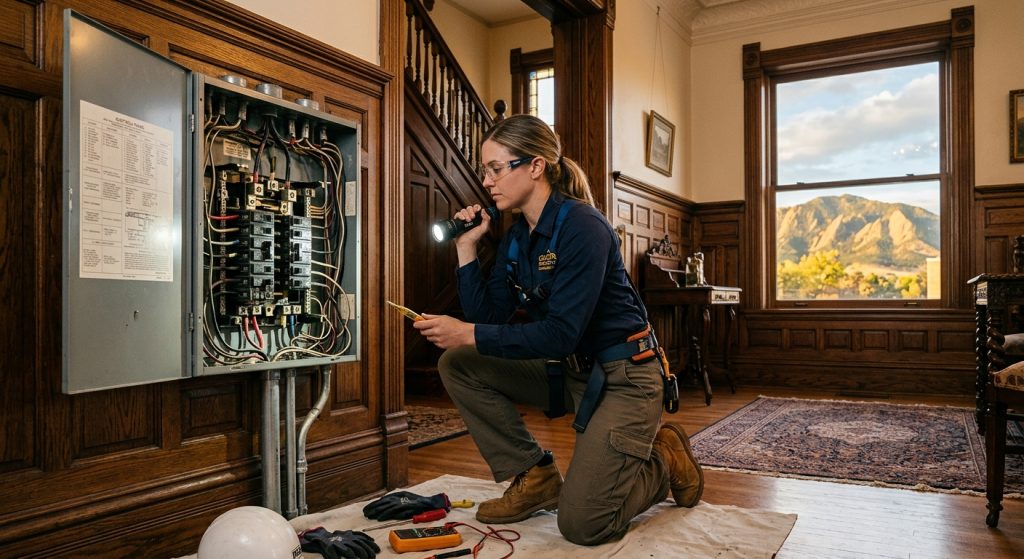
Older homes in Golden often contain outdated electrical systems that general inspections might overlook. Specialized safety evaluations identify hazardous materials like knob and tube or aluminum wiring and recalled panels. These inspections ensure antique systems can handle modern power demands while uncovering unpermitted work that could affect property value.
Professional inspections help buyers negotiate repairs and ensure compliance with local building codes. Expert assessments mitigate fire risks and shock hazards by recommending necessary upgrades such as GFCI protection or panel replacements. This process provides peace of mind and protects the long-term safety of historic property investments.
Buying an Older Home in Golden? Why You Need an Electrical Safety Inspection
Driving under the iconic “Welcome to Golden” arch, it is easy to see why so many people fall in love with our city. Between the stunning views of the foothills, the rich history surrounding the School of Mines, and the vibrant local culture near the Coors Brewery, Golden offers a quality of life that is hard to beat. For many homebuyers, the ultimate dream is purchasing one of the beautiful, historic homes nestled in Downtown Golden, Applewood, or up in Mesa Meadows.
These older properties have incredible character, mature trees, and a sense of craftsmanship that you simply cannot find in modern, cookie-cutter subdivisions. However, behind those charming lath-and-plaster or vintage drywall surfaces, there is often a hidden, invisible system that hasn’t aged quite as gracefully as the hardwood floors: the electrical wiring.
If you are in the process of buying an older home in our area, you are likely already scheduling a standard home inspection. But when it comes to homes built before 1990—and especially those built in the 1950s, 60s, or earlier—a general inspection simply isn’t enough. At Ponderosa Heating, Air, Plumbing, Electrical, we want to help our neighbors protect their investments. Here is an in-depth look at why a dedicated electrical safety inspection by a licensed local professional is absolutely critical before you close on a vintage Golden property.
The Difference Between a General Home Inspection and an Electrical Safety Inspection
When you hire a general home inspector, they perform a broad, visual overview of the entire property. They check the roof, look for foundation cracks, test the plumbing pressure, and ensure the HVAC system turns on. When it comes to the electrical system, a general inspector will typically test a representative number of wall outlets, flip the light switches, and open the main panel door to look for obvious, glaring hazards.
However, general home inspectors are exactly that—generalists. They are not licensed electricians. They are generally not permitted to remove the dead front cover of an electrical panel to inspect the main bus bars, the torque of the breaker lugs, or the integrity of the branch circuit wiring deep inside the box. According to the Electrical Safety Foundation International (ESFI), relying solely on a general inspection can leave severe, hidden electrical fire hazards completely undetected.
A dedicated electrical safety inspection, also known as a “home buyer electrician check,” is a comprehensive, deep-dive evaluation performed by a licensed professional. We look beyond the surface. We evaluate the system’s capacity, inspect the physical condition of the wire insulation, check for illegal or unpermitted homeowner modifications, and verify that the system can handle the rigorous demands of modern technology.
The Top Electrical Red Flags Hidden in Golden’s Older Homes
When we perform comprehensive electrical panel and wiring inspections in older neighborhoods like Applewood or Tablerock, we consistently run into a few specific, outdated technologies that pose severe risks to your property. If you are buying a home, you need to know if any of these four hazards are lurking behind the walls.
1. Knob and Tube Wiring
If you are looking at a beautiful Victorian or early 20th-century home near Downtown Golden, there is a chance it still contains knob and tube (K&T) wiring. Used roughly from the 1880s through the 1940s, this system consists of single-insulated copper conductors run through porcelain insulating tubes and supported along their length by porcelain knobs.
The major problem with knob and tube wiring is that it completely lacks a grounding conductor. Modern electrical systems use a ground wire to safely divert rogue electricity back to the earth in the event of a fault. Without a ground, an electrical fault in a K&T system can easily shock a person or spark a fire. Furthermore, the rubber insulation used on these old wires degrades, turns brittle, and falls off over the decades, leaving bare, live wires exposed inside your walls. Finally, many insurance companies will outright refuse to write a homeowner’s policy—or will charge astronomical premiums—if a home has active knob and tube wiring.
2. The Aluminum Wiring Boom
During the late 1960s and early 1970s, the price of copper skyrocketed. To keep construction costs down, many builders switched to using single-strand aluminum wiring for household branch circuits. If the home you are buying was built or remodeled during this era, it is a massive red flag.
The Consumer Product Safety Commission (CPSC) has extensively documented the fire hazards associated with aluminum wiring. Aluminum expands and contracts at a much higher rate than copper when it heats up and cools down (a process known as “creep”). Over time, this constant expansion and contraction causes the wire connections at outlets, switches, and the main breaker panel to become loose. Loose electrical connections create microscopic electrical arcing. This arcing generates intense, localized heat that can easily ignite the surrounding wood framing inside your walls. Outdated wiring replacement or specialized remediation (like AlumiConn splicing) is absolutely essential if we find this in your potential new home.
3. Outdated and Recalled Electrical Panels
The electrical panel is the beating heart of your home’s power system. Its primary job is to distribute power and, most importantly, to trip the breaker and stop the flow of electricity if a circuit becomes overloaded.
In older homes, we frequently find heavily outdated or even recalled electrical panels. The two most infamous are Federal Pacific Electric (FPE) “Stab-Lok” panels and Zinsco panels. These were installed in millions of homes between the 1950s and the 1980s. Testing has proven that the breakers in these specific panels have an unacceptably high failure rate. When a circuit overloads, an FPE or Zinsco breaker may fail to trip, allowing the wires to overheat, melt, and start a fire. If your prospective home has one of these panels, an electrical panel upgrade is an immediate, non-negotiable safety requirement.
4. Lack of GFCI and AFCI Protection
Modern electrical codes are written in blood; they evolve based on past tragedies to make homes safer. Ground Fault Circuit Interrupters (GFCIs) protect you from fatal electrical shocks in wet areas, while Arc Fault Circuit Interrupters (AFCIs) protect your home from electrical fires caused by sparking wires.
Older homes were built long before these protections were mandated. We frequently find kitchens, bathrooms, garages, and exterior outlets without any GFCI protection. If you drop a hair dryer into a sink in a modern home, the GFCI cuts the power in milliseconds. In a 1960s home without a GFCI outlet, that same scenario could be fatal. A thorough safety inspection identifies exactly where these modern protections need to be retrofitted.
Modern Life vs. Antique Power: The Load Problem
Even if an older home’s wiring is technically safe and in good physical condition, there is another massive issue you must consider: electrical capacity.
When a home in Applewood was built in 1965, the electrical demands of the average family were incredibly small. You had a few incandescent light bulbs, a refrigerator, a basic television, and a radio. To accommodate this, builders typically installed 60-amp or 100-amp main electrical services.
Fast forward to today. We live in an era of massive electrical consumption. You likely have multiple large flat-screen televisions, a high-efficiency central air conditioner, a home office with dual monitors and a powerful computer, a microwave, an air fryer, an induction cooktop, and possibly even an electric vehicle (EV) charging station in the garage.
An antique 60-amp or 100-amp electrical panel simply cannot handle the load of a modern family. If you try to run your modern lifestyle on a vintage panel, you will constantly trip breakers, experience flickering lights, and put a dangerous amount of thermal stress on your home’s main wiring. During our home buyer electrician check, we perform a detailed “load calculation.” We look at your family’s technology needs and determine if the home requires a heavy-up (a service upgrade to a 200-amp or even a 400-amp panel) to safely support your lifestyle.
Why DIY Fails: The Danger of “Fixing” Old Wiring
When you purchase an older home, it is incredibly tempting to want to tackle renovations yourself to save money. We see plenty of homeowners watching a few internet videos and deciding to swap out their own outlets, install their own ceiling fans, or even try to add new breakers to an old panel.
We strongly advise against this. When it comes to vintage electrical systems, DIY attempts usually fail, and they fail dangerously.
Here is why a local pro is safer: Old wiring is incredibly fragile. The insulation on wires from the 1950s can be so brittle that simply pulling the wire out of the wall box to replace a light switch can cause the insulation to crumble away in your hands, leaving a live, bare wire waiting to short out against the metal box. Furthermore, older homes are notorious for containing decades of illegal, unpermitted “handyman specials”—wires spliced together with tape instead of wire nuts, hidden junction boxes buried behind drywall, and overloaded circuits.
You cannot rely on internet tutorials to teach you how to navigate a tangled, undocumented web of 60-year-old wiring. Touching the wrong wire inside a main panel can result in a lethal shock or an immediate arc flash explosion. You need a highly trained, licensed professional who understands the deep nuances of historic home construction.
The Added Stress of Local Traffic and Weather
Living in Golden is amazing, but we all know that our local infrastructure has its quirks. Whether you are navigating the roundabouts on South Golden Road during the morning commute, dealing with the massive influx of weekend recreational traffic heading up into the canyons, or preparing for severe winter storms, you have enough on your plate.
When the winter winds howl and the snow begins to fall heavily, the last thing you want to worry about is whether your home’s antique electrical panel is going to fail and leave you without power—or worse, cause a fire. You want to relax in your beautiful new home with absolute peace of mind. Ensuring your electrical system is up to code, safe, and fully modernized means your home becomes the safe, warm sanctuary it is supposed to be. Furthermore, checking that your smoke detectors are up to code and hardwired into a reliable electrical system is a critical final step in our inspection process.
Our Comprehensive Electrical Inspection Process
When you call Ponderosa Heating, Air, Plumbing, Electrical to inspect a home you are buying, we leave no stone unturned. Our process is designed to give you a crystal-clear picture of the home’s electrical health so you can negotiate repairs with the seller or plan your renovation budget accurately.
Our comprehensive check includes:
- Main Service Panel Evaluation: We remove the dead front cover to inspect the main lugs, check for signs of moisture intrusion, verify the grounding and bonding system, and ensure no recalled breakers are present.
- Wiring Integrity Check: We examine exposed wiring in the attic, basement, and crawlspaces to identify knob and tube, aluminum, or degraded cloth-covered wire, as detailed by safety organizations like the National Fire Protection Association (NFPA).
- Receptacle and Switch Testing: We use advanced diagnostic tools to test a wide variety of outlets for proper polarity, grounding, and voltage drop under load.
- Code Compliance Review: We map out where modern safety devices (GFCIs and AFCIs) are missing and provide a straightforward plan to retrofit them.
Local Permitting Nuances: Navigating Golden and Jefferson County
One of the biggest issues we find with older homes is unpermitted electrical work. If a previous owner finished a basement or upgraded a kitchen without pulling the proper permits through the City of Golden or Jefferson County, you—as the new buyer—could be inheriting a massive liability.
We check for signs of “bootleg” wiring and unpermitted electrical outlet installations. If we find code violations, it is vital to know before you sign the closing papers. Because we work locally in Golden and throughout the metro area every day, we understand exactly what the local building department requires. If you choose to hire us to fix any issues we find during the inspection, we handle all the permit pulling, county scheduling, and final municipal inspections for you. We make sure the work is 100% legal, up to code, and safe.
Frequently Asked Questions
Can a house “fail” an electrical inspection in Golden?
Technically, no. An inspection for a home purchase is not a “pass/fail” test. Instead, it provides you with a comprehensive report of safety hazards and code violations. You can use this report to understand the health of the home and to negotiate with the seller.
Can I negotiate electrical repairs with the seller?
Yes! In fact, electrical safety issues (like an active FPE panel or exposed knob and tube wiring) are some of the most successfully negotiated items during a real estate transaction. Because these are critical life-safety hazards, buyers often successfully request that the seller cover the cost of the repair or lower the asking price accordingly.
How long does a home buyer’s electrical inspection take?
Depending on the size of the property and how accessible the panels and wiring are, a thorough inspection by our team generally takes between one and two hours.
Why Hiring Ponderosa is the Best Choice for Your Home
When you are buying a house, you already have to coordinate with realtors, mortgage brokers, and title companies. The last thing you need is the stress of managing multiple different home service contractors.
At Ponderosa Heating, Air, Plumbing, Electrical, we are your local neighbors, and we provide complete, whole-home services. If our electrical inspection uncovers a panel issue, we can fix it. But if you also notice a leaky pipe or realize the furnace needs a tune-up before winter hits the foothills, you only have to make one phone call. We protect your home from top to bottom.
Buying a historic home in Golden should be an exciting milestone, not a source of hidden anxiety. Before you sign those closing documents, make sure you know exactly what is hiding behind the drywall. Whether you need a thorough inspection, a complete whole-house wiring replacement, or just a panel upgrade to support your new electric vehicle, our team of friendly, local experts is here to help. We provide honest advice, clear explanations, and neighborly service you can trust.
Our initial service call fee is $189, but this is completely waived (making your quote free) if you choose us for the work.
Call us today at 720-470-1133 or fill out our online contact form to schedule your home buyer electrical safety inspection. Let’s make sure your piece of Golden history is safe, reliable, and ready for your family’s future.
