
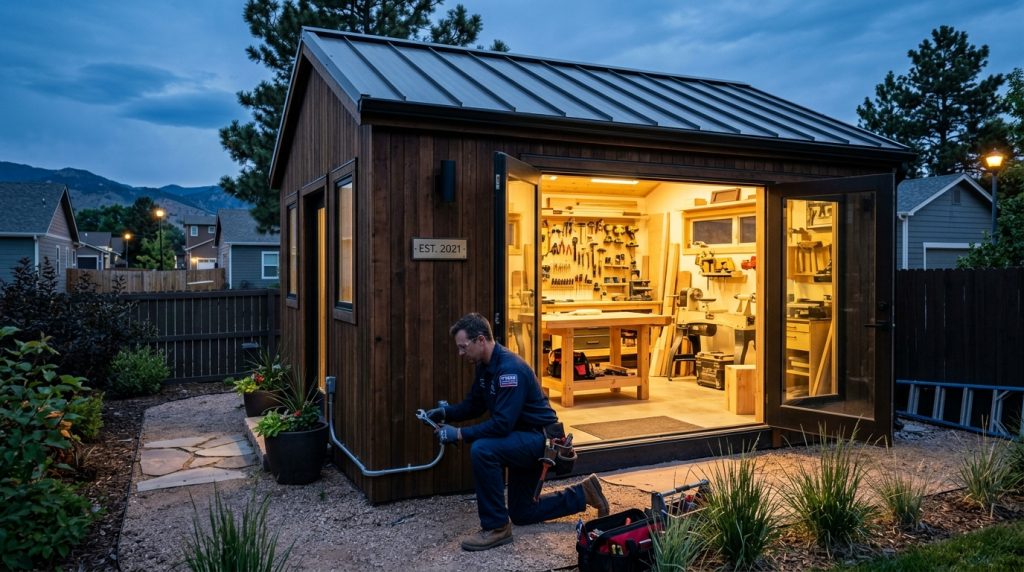
Professional shed wiring in Denver requires detailed planning for electrical loads and sub-panel installation. Proper execution involves trenching conduits to specific depths to meet local building codes and withstand Colorado soil conditions. This process ensures reliable power for high-draw machinery while preventing voltage drops over long distances.
Licensed installations include essential safety features such as grounding rods and arc-fault protection to mitigate fire risks. Professional services ensure compliance with municipal regulations and secure necessary permits for insurance and property valuation. These steps address the technical requirements of detached structures, including specialized wiring for workshops and offices.
Power Your Workshop: Shed Wiring Done Right
Whether you’re building a professional woodworking shop in Harvey Park, setting up a quiet home office in Westwood, or creating a high-end home gym in Athmar Park, having reliable power in your backyard structure is a total game-changer. A “shed” is no longer just a place to store a rusty lawnmower; today, these detached spaces are sophisticated extensions of our homes that require robust electrical support to function safely and effectively.
However, running electricity to a shed in Colorado is a major undertaking that involves much more than just a heavy-duty extension cord and a prayer. Because these structures are exposed to the elements and require their own dedicated power management, the job must be done with precision to avoid fire hazards, voltage fluctuations, and expensive code violations. At Ponderosa Heating, Air, Plumbing, Electrical, we specialize in helping our neighbors bridge the gap between their main house and their backyard dreams. Here is a technical look at how to handle shed wiring in Denver the right way.
1. Planning Your Outdoor Workshop Electrical Needs
Before we even break ground for a trench, we have to determine exactly what you plan to do in your new space. An outdoor workshop electrical plan for a simple potting shed with a single LED light is vastly different from a plan for a detached garage where you might be running a table saw, a dust collector, and an electric space heater simultaneously.
In professional electrical design, we perform a “load calculation” for your shed. We look at the “startup surge” of your power tools—the moment a saw motor kicks on and draws three times its running amperage. If you’re planning on more than just light usage, we typically recommend a sub-panel. This acts as a miniature breaker box inside your shed, allowing you to manage your circuits locally. This is especially important for detached garage wiring in Denver where you might eventually want to add a Level 2 EV charger, a mini-split HVAC unit, or a powerful air compressor.
Pro Tip
Think about your future needs now. It is significantly more cost-effective to install a 60-amp or 100-amp sub-panel today than it is to realize next year that your 20-amp single circuit can’t handle your new welder or 3D printing station. We always suggest “oversizing” your conduit and panel capacity slightly to give your hobbies and your home’s value room to grow.
2. The Logistics: Digging and Trenching in Colorado
Getting the power from your main home panel to the detached structure is the most labor-intensive part of the process. In Denver and across the Front Range, we have strict codes regarding how deep your electrical lines must be buried to protect them from garden shovels, landscaping projects, and the constant freezing and thawing of our Colorado soil.
- Trenching Depth and Conduit: We typically bury PVC or rigid metal conduit at least 18 to 24 inches underground. In the rocky, clay-heavy soil often found in our local foothills and Southwest Denver neighborhoods, this requires specialized trenching equipment and professional muscle. We also handle the “Utility Locate” (calling 811) to ensure we don’t accidentally nick your gas or water lines during the dig.
- Managing “Voltage Drop”: This is a technical factor that many DIYers overlook. If your shed is 100 feet or more from your house, the electricity loses pressure (voltage) as it travels through the wire. To compensate for this, we have to use thicker, more expensive gauge wire to ensure your tools don’t “bog down” or overheat due to low voltage.
- The “Main” Connection: We must ensure your home’s existing electrical panel has the physical space and the electrical “headroom” to support the new shed. If your panel is already 15-20 years old and showing signs of strain, we might need to perform a service upgrade before we can safely add the shed’s load to your home’s grid.
3. DIY vs. Professional Comparison
It is incredibly tempting to try a DIY “hack” like running an extension cord through a garden hose or burying indoor-rated wire just a few inches deep. However, these are leading causes of backyard electrical fires and can lead to fatal shocks if a lawnmower or shovel cuts the line. Here is why choosing a professional shed wiring in the Front Range expert is the only safe path:
| Feature | DIY Approach | Ponderosa Professional Install |
| Safety Risk | Extremely High (Shock/Fire) | Zero (Licensed & Insured) |
| Code Compliance | Likely a major violation | Guaranteed NEC & Local Standards |
| Power Output | Often weak (Voltage drop) | Optimized for high-draw machinery |
| Resale Value | Can fail home inspections | Adds documented, permitted value |
| Durability | Prone to moisture & rodent damage | Weather-proofed and armored |
| Warranty | None (You pay for mistakes) | Full Labor & Satisfaction Guarantee |
Pro Tip
If a future home inspector finds unpermitted or “handyman” wiring running to a detached structure, they will flag it as a high-priority safety hazard. This can stall the sale of your home or force you to pay for expensive “emergency” removals or corrective work. Doing it right the first time with an electrician for shed power in Denver protects your property and your family.
4. Why You Need a Licensed Electrician for Shed Power
Beyond just making the lights turn on, a professional electrician for shed power in Denver ensures the entire system is properly grounded and protected against the unique weather we face in the Metro Area.
- GFCI and AFCI Protection: All outdoor and workshop outlets must have Ground Fault Circuit Interrupter (GFCI) protection to prevent shocks in damp environments. We also install Arc Fault (AFCI) protection to stop sparks—caused by something like a frayed power tool cord—before they start a fire in your workshop.
- Secondary Grounding Rods: Detached structures with their own sub-panels often require their own separate grounding rod driven eight feet into the earth. This protects your expensive shop equipment and your life in the event of a lightning strike or a power surge—a very real threat during our intense Colorado spring and summer storms.
- Permitting and Documentation: We handle all the paperwork with the City of Denver or Jefferson County. This ensures that a neutral third-party inspector verifies the work is safe. Having a permitted electrical system is a massive plus when it comes to your home’s insurance and future resale value.
5. Local Homeowner FAQ: Shed Power in Denver
How much does a shed power installation in Colorado cost?
The shed power installation in Colorado costs vary depending on the distance from your main house, the soil conditions (rocky vs. soft), and how much power you need. A 50-foot run for a home office is a different project than a 150-foot run for a full woodworking shop. We provide clear, transparent quotes after an on-site assessment.
Can I run my shed off a solar panel instead?
While small solar kits can power a single LED light or charge a phone, they cannot handle the “startup surge” of a vacuum, a saw, or a space heater. If you want a functional workspace that works 24/7, you need a hard-wired connection to your home’s grid.
Does my shed need its own breaker box?
If you are only running one light and one outlet for very light use, you might get by with a single dedicated circuit. However, for any workshop, gym, or office, a sub-panel is the industry standard for safety, convenience, and future-proofing.
Let Ponderosa Power Your Passion
Don’t let a lack of outlets or a flickering extension cord hold back your backyard hobbies. Whether you’re planning a detached garage wiring in Denver project or you need a reliable electrician for shed powerto light up your new backyard studio, our team of neighborly experts is ready to help. We provide plain-English explanations, clear pricing, and craftsmanship that stands up to the harsh Colorado elements.
Our initial service call fee is $189, but this is completely waived (making your quote free) if you choose us for the work. We want to make sure your workshop is a place of productivity and creativity, not a place of electrical worry.
Call us today at 720-470-1133 or fill out our online contact form to schedule your shed wiring consultation. Let’s get your new space powered up the right way.
