
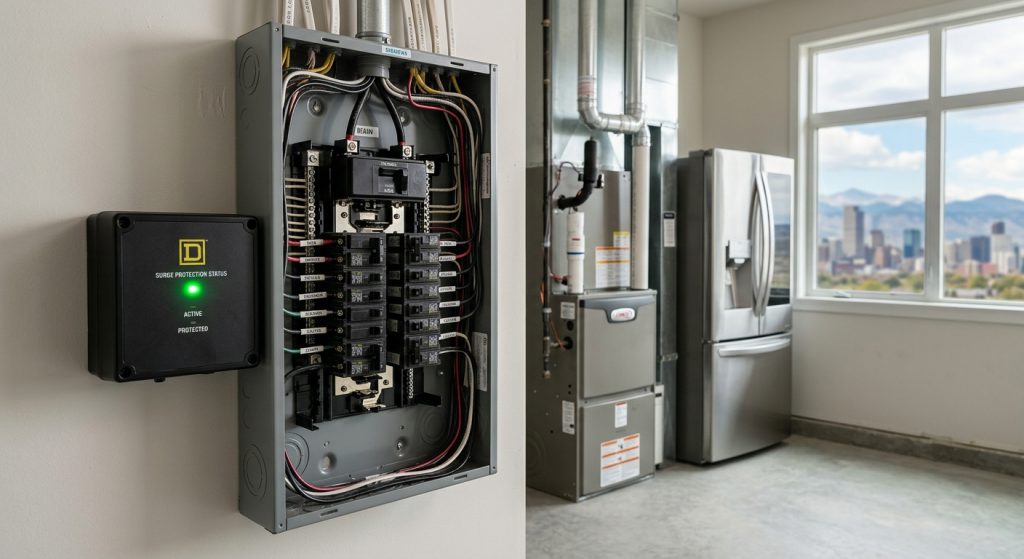
Southwest Denver homeowners face frequent electrical surges from industrial activity and internal appliance cycling. While common power strips provide some protection for plugged-in devices, they cannot safeguard expensive hardwired systems like HVAC units and major appliances. These basic strips also degrade over time and lack the capacity for major spikes.
Professional whole-home surge protection offers a comprehensive solution by diverting excess voltage directly at the electrical panel. Licensed installation ensures safety, maintains equipment warranties, and complies with local Denver building codes. This proactive approach prevents costly damage to modern electronics and preserves the longevity of a home’s entire electrical infrastructure.
Why Power Strips Aren’t Enough: Whole-Home Surge Protection in Southwest Denver
Living in Southwest Denver offers an incredible, diverse lifestyle. Whether you are catching a free summer concert at the Levitt Pavilion in Ruby Hill, supporting the fantastic community agriculture projects over at the Re:Vision hub in Westwood, or just enjoying the quiet, mid-century charm of Harvey Park, this side of the metro area is truly special. However, our vibrant mix of residential neighborhoods and heavy industrial corridors brings a unique, invisible challenge directly into our homes: dirty power and electrical surges.
Most homeowners think they are completely protected because they have a $15 plastic power strip tucked behind their television or computer desk. Unfortunately, in the modern era of smart appliances and high-efficiency home systems, those basic power strips offer a dangerous illusion of safety.
At Ponderosa Heating, Air, Plumbing, Electrical, we have seen firsthand the devastating financial impact a sudden electrical spike can have on a home. When thousands of dollars in hardwired appliances are destroyed in a fraction of a second, the frustration is immense. Here is an in-depth look at what actually causes power surges in Southwest Denver, why basic power strips are failing to protect you, and why investing in a professional electrical surge protection installation is the only way to safeguard your entire home.
The Invisible Threat: What Actually Causes Power Surges?
To understand how to protect your home, you have to understand what a power surge actually is. In the United States, our homes are designed to run on a steady, alternating current of 120 volts. An electrical surge (or transient voltage) is a brief, massive spike in this voltage. These spikes last only microseconds, but they can carry thousands of extra volts through your home’s delicate wiring.
While most people immediately picture a massive summer thunderstorm rolling over the Front Range, lightning is only responsible for a small fraction of home electrical damage. According to the Electrical Safety Foundation International (ESFI), nearly 80% of all power surges are generated internally, right inside your own home.
1. The Southwest Denver Industrial Mix
Our area is unique because dense residential neighborhoods often sit directly adjacent to heavy commercial and industrial zones along the Alameda and Federal Blvd corridors. When massive industrial machinery, manufacturing equipment, or commercial HVAC systems power on and off, they pull enormous amounts of electricity from the local grid. This constant shifting of power demands creates external fluctuations—often referred to as “dirty power”—that bleed directly into the residential grid and your home’s electrical panel.
2. Internal Appliance Cycling
The biggest culprit inside your home is the cycling of large motors. Every time your refrigerator compressor kicks on, or your central air conditioner starts up, it requires a massive jolt of electricity. Once the motor gets spinning, that excess energy is abruptly shut off. This creates a micro-surge that travels back through your home’s wiring. These micro-surges are small, but they happen dozens of times a day. Over months and years, this constant electrical “pounding” degrades the microscopic circuit boards inside your modern appliances until they mysteriously fail.
3. Grid Switching and Downed Lines
High winds and severe winter storms frequently cause tree branches to hit power lines in older neighborhoods. When Xcel Energy works to restore power or switch grid loads to deal with outages, the sudden rush of electricity coming back online creates a massive surge that can instantly fry unprotected electronics.
The Power Strip Illusion: Why Your Home is Still at Risk
We all use power strips. They are great for adding extra outlets behind an entertainment center. But as a primary defense system, they are entirely insufficient for protecting home electronics for three critical reasons:
They Only Protect What is Plugged In: Think about the most expensive electrical devices in your home. Your central AC compressor, your high-efficiency furnace, your smart refrigerator, your dishwasher, your washer and dryer, and your LED lighting system. None of these are plugged into a cheap power strip. They are hardwired directly into your home’s electrical panel. When a surge hits, these expensive appliances take the full, unfiltered impact. Replacing a fried control board on a modern air conditioning system can easily cost over a thousand dollars.
They Degrade Over Time:
Surge-protecting power strips use a component called a Metal Oxide Varistor (MOV) to divert excess voltage. MOVs are sacrificial; they degrade a little bit every time they absorb a surge. A power strip that is three or four years old has likely absorbed so many micro-surges that its internal protection is completely gone. It is now just an extension cord, but you have no way of knowing it until your electronics start smoking.
They Cannot Handle Massive Energy:
Power strips are rated in “joules,” which measures how much energy they can absorb. A standard strip might be rated for 800 to 1,000 joules. A major grid surge or a nearby lightning strike can send tens of thousands of joules of energy into your home, instantly overwhelming and destroying the plastic strip and everything attached to it.
The Solution: Finding a Whole Home Surge Protector in Denver
The only effective way to protect your property is to stop the surge before it ever enters your home’s internal wiring. This is accomplished with a whole-home surge protector.
Unlike a strip that sits on your living room floor, a whole-home unit is a heavy-duty, commercial-grade device that a licensed electrician hardwires directly into your main electrical service panel. It acts as a massive, intelligent gatekeeper for your entire house.
When a surge travels down the power lines from the street, the whole-home protector instantly detects the excess voltage. Within nanoseconds, it intercepts the dangerous energy and shunts it safely straight into your home’s foundational grounding system, entirely bypassing your breakers, your wiring, and your appliances.
This provides a “blanket” of protection over everything in the house. Your hardwired oven, your electrical sub-panels, your expensive home office equipment, and your HVAC system are all shielded simultaneously.
Why DIY Electrical Installation Fails (And the Dangers Involved)
With the rise of internet tutorial videos, many homeowners are tempted to buy a whole-home surge protector online and try to wire it into their breaker box themselves to save money. We cannot stress this enough: Never open your main electrical panel unless you are a licensed electrician. Here is exactly why DIY fails and why relying on a local pro is safer:
The Risk of Arc Flash and Electrocution
Even if you turn off the main breaker to your house, the thick service wires coming into the top of the panel (the main lugs) remain fully energized with raw, unfused power directly from the street transformer. If you accidentally drop a screwdriver, touch a wire, or brush against those lugs while trying to install a surge protector, the result can be a lethal electrocution or a blinding arc flash explosion.
Voiding Equipment Warranties
High-quality whole-home surge protectors come with extensive warranties—often covering up to $50,000 or more in damage to your connected home appliances if the unit fails to stop a surge. However, the fine print on these manufacturer warranties strictly dictates that the unit must be installed by a licensed professional. A DIY installation immediately voids the warranty, leaving you completely unprotected financially.
Incorrect Breaker Sizing and Wire Routing
Surge protectors must be wired to a dedicated, correctly sized dual-pole breaker, and the wires must be kept as short and straight as possible to maximize their reaction time. A professional knows how to optimize the installation so the unit functions at its absolute peak performance.
Local Permitting Nuances in Denver
When you modify the main electrical panel in your home, you are performing structural electrical work. In the City and County of Denver, installing a whole-home surge protector legally requires pulling an electrical permit and having the work inspected by a municipal inspector.
If you hire an unlicensed handyman who bypasses the permitting process, you are taking a massive risk. If an unpermitted electrical modification causes a fire, the Insurance Information Institute (III) warns that your homeowner’s insurance policy may completely deny your claim.
Because we work locally in Southwest Denver every single day, we understand the local building codes inside and out. If you hire Ponderosa Heating, Air, Plumbing, Electrical, we handle the entire permitting and inspection process for you. We make sure the work is 100% legal, up to code, and safe.
Frequently Asked Questions: Home Surge Protection
u003cstrongu003eWill a whole-home surge protector stop a direct lightning strike?u003c/strongu003e
If lightning strikes your home’s roof directly, nothing can stop that level of raw energy. However, direct strikes are incredibly rare. The vast majority of lightning-related damage occurs when lightning strikes a power pole down the street or hits the ground nearby, sending a massive surge through the municipal grid. A whole-home protector is highly effective at stopping these grid-level lightning surges.
u003cstrongu003eDo I still need to use power strips inside the house?u003c/strongu003e
Yes! The absolute best defense is a u0022layeredu0022 approach. A whole-home protector acts as the primary shield, catching the massive surges from the outside grid. However, if a small internal micro-surge is generated by an old refrigerator cycling on inside the house, a high-quality point-of-use surge strip acts as a secondary net to catch any remaining voltage before it reaches your sensitive computer or television.
u003cstrongu003eHow long do whole-home surge protectors last?u003c/strongu003e
Most high-quality units are designed to last for roughly 5 to 10 years, depending on how many severe surges they absorb from the local grid. Modern units feature bright LED indicator lights on the front cover. If the light is green, your home is protected. If the light goes out, it means the unit has sacrificed itself to save your home and needs to be replaced.
Why Ponderosa is the Best Choice for SW Denver
Navigating the congestion on Federal Blvd or dealing with the high speeds on Alameda is stressful enough. You shouldn’t have to deal with the stress of wondering if your home’s electrical system is safe.
When you call Ponderosa Heating, Air, Plumbing, Electrical, you are calling your local neighbors. We provide complete home services. Because we understand if your electrical panel is a fire risk, we can perform a full safety evaluation of your wiring while we install your surge protection. If you are also curious about protecting your home from winter blackouts with a whole-house generator, we can discuss all your options during a single visit. We don’t use confusing industry jargon; we provide clear, honest advice you can trust.
Our initial service call fee is $189, but this is completely waived (making your quote free) if you choose us for the work.
Call us today at 720-470-1133 or fill out our online contact form to schedule your whole-home surge protection installation. Let’s make sure your appliances, your electronics, and your Southwest Denver home stay completely safe.
Related reading: How Long Does a Fridge Stay Cold Without Power? Food Safety Tips
